We Made a Battery Out of Lemons
You’ve held a battery a thousand times. But what actually is one? That’s the question the boys and I set out to answer this weekend — with a bag of lemons, a handful of hardware-store parts, and one very patient LED. It’s Experiment 5 from Make: Electronics by Charles Platt, and it turned our kitchen counter into a chemistry lab.
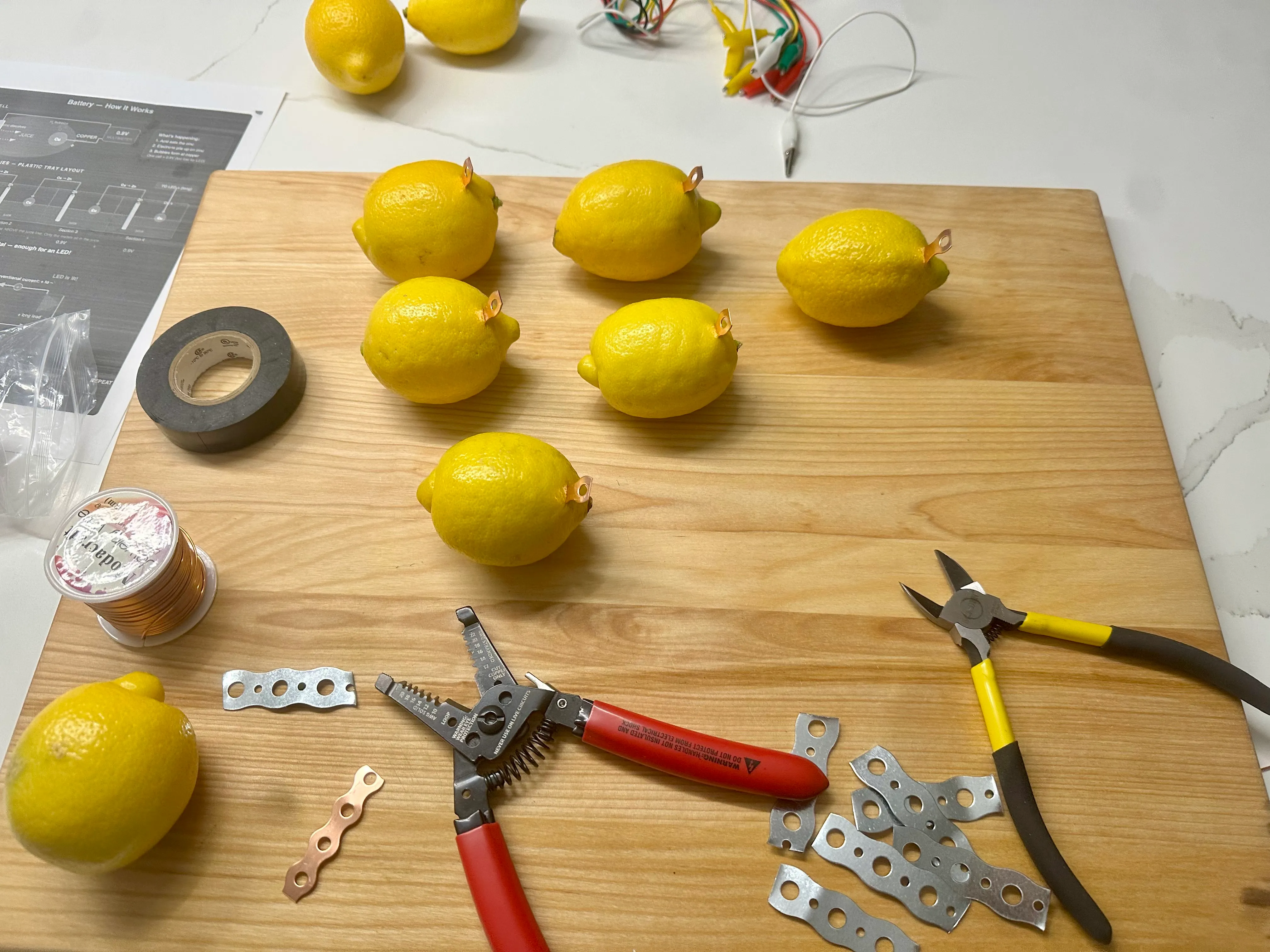
The parts list is delightfully weird
A battery needs exactly three ingredients: two different metals and an acid between them. Ours were:
- Lemons — the acid (citric, in this case). The electrolyte that makes everything go.
- Copper — small copper strips, one pushed into each lemon. This is the positive electrode.
- Zinc — galvanized mending plates from the hardware store. “Galvanized” just means zinc-coated, and that coating is the star of the whole show.
- Alligator clip leads, a green LED, and a multimeter to see what we’d built.
One lemon is not enough — and that’s the lesson
Push a copper strip and a zinc bracket into a lemon (close together, not touching), put the multimeter across them, and you get about 0.9 volts. Real electricity, made by fruit! The boys’ eyes went wide at the number on the meter.
Then comes the disappointment that teaches the good stuff: 0.9V won’t light an LED. An LED needs roughly 2 volts before it will even wake up. One lemon, no matter how big, will never get there — the voltage is fixed by the metal pairing, not the size of the fruit.
The fix is the same trick we’d met in an earlier experiment: put cells in series and their voltages add. Copper of one lemon to zinc of the next, copper to zinc, copper to zinc, down the line. Every junction adds another ~0.9V to the stack. We chained up our lemons, took the two free ends — zinc at one end, copper at the other — and clipped in the LED.
It glowed.
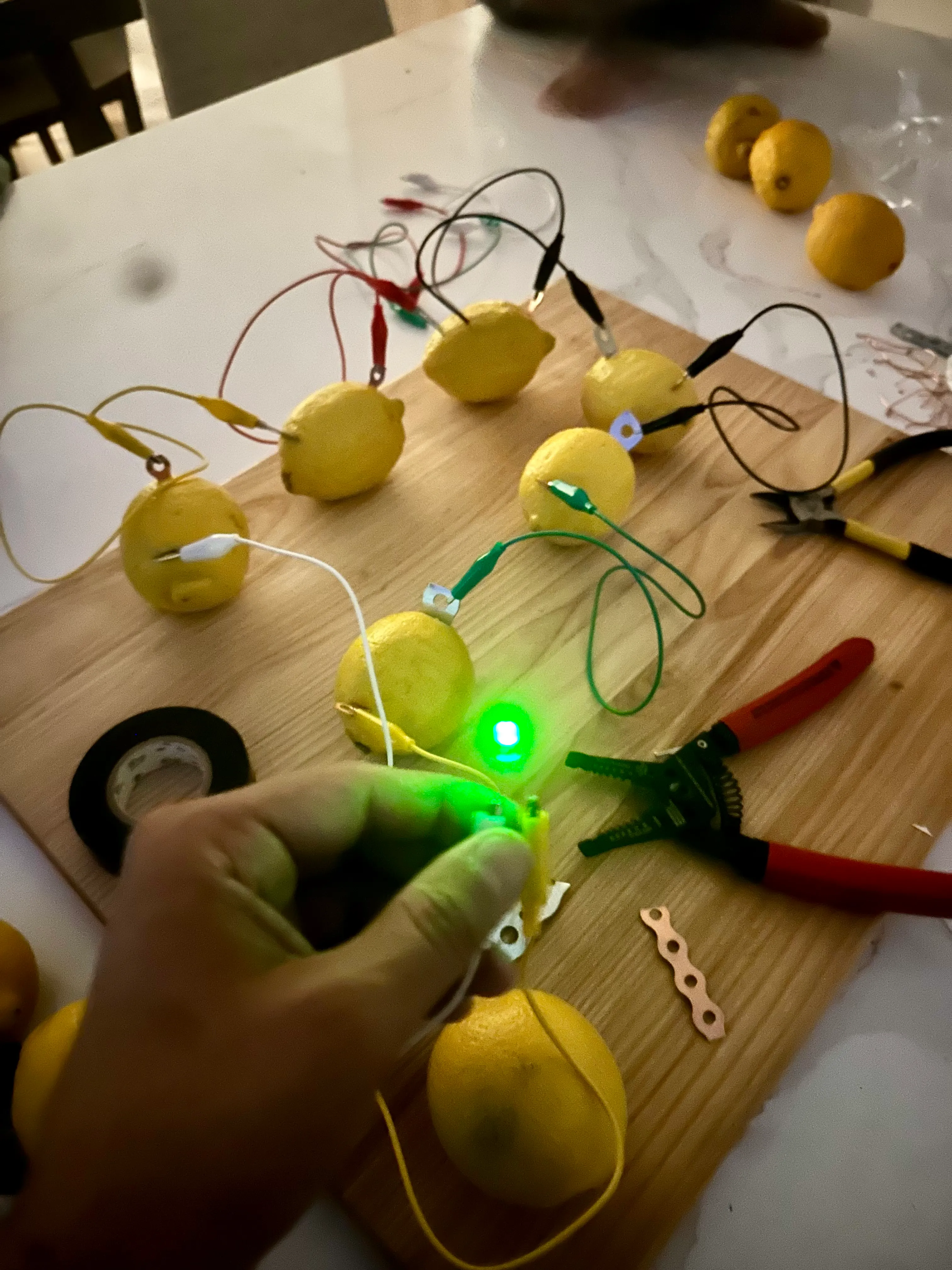
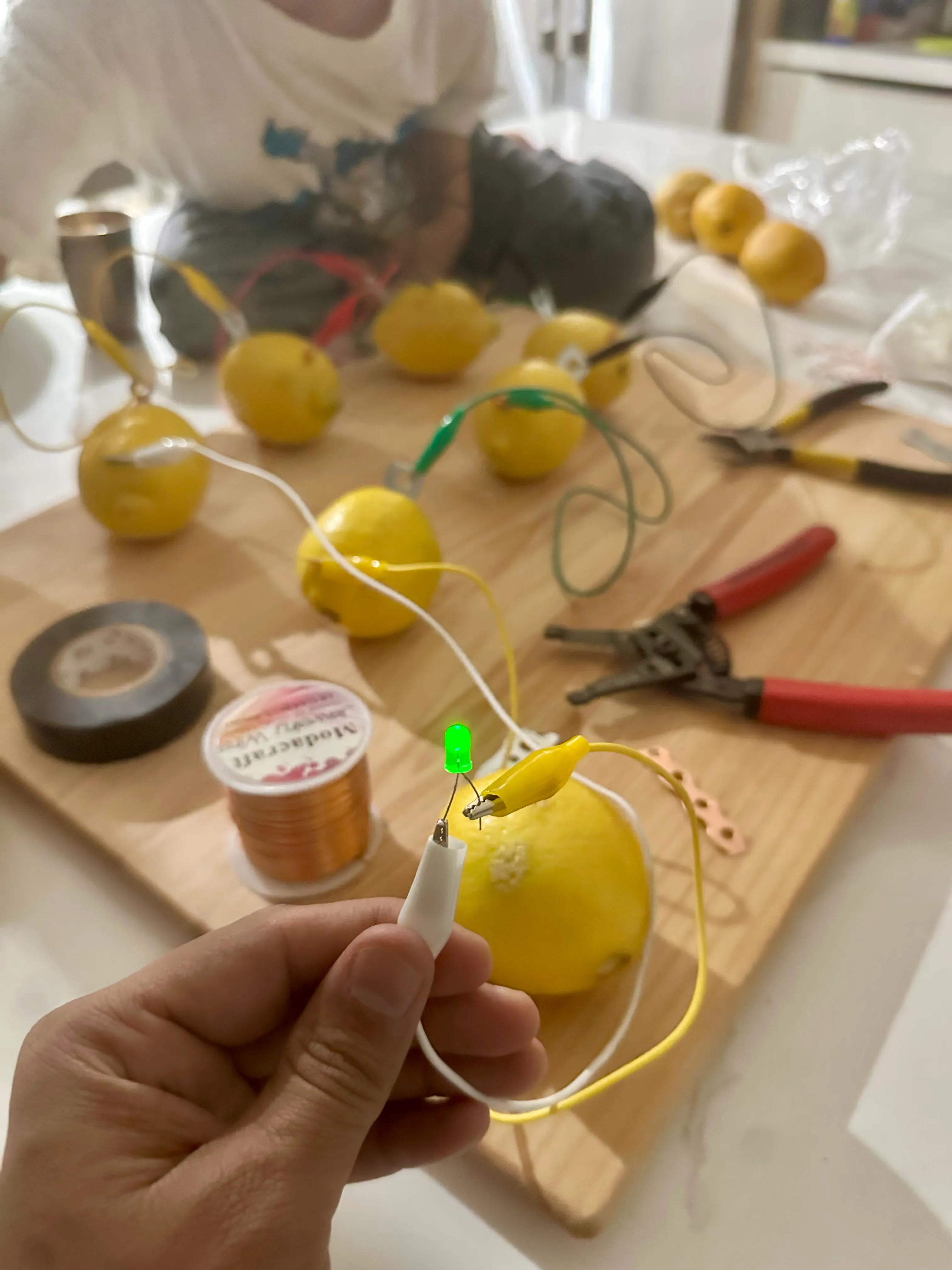
There is something genuinely magical about that dim green light. No outlet, no battery pack — just fruit, metal, and chemistry, and a kid holding it going “it’s working, it’s working!”
What’s actually happening in there
The part I enjoyed explaining most, because it’s simpler than it looks:
- The lemon’s acid attacks the zinc. Zinc atoms dissolve into the juice, but each one leaves two electrons behind on the bracket — so electrons pile up with nowhere to go.
- Connect the wire, and those piled-up electrons finally have a path: through the wire, through the LED (that’s the glow — electrons losing energy on the way through), and over to the copper.
- At the copper strip, the arriving electrons get collected by hydrogen ions from the acid, which turn into tiny bubbles of hydrogen gas and float away — the battery’s exhaust. (Supposedly you can see the bubbles form if the reaction is strong enough. We looked; ours kept their exhaust to themselves.)
- Repeat until the zinc runs out. When people say a battery is “dead,” this is what they mean: the reactive metal has been eaten.
The copper, funnily enough, does nothing chemically. It’s just the autobahn — a fast, easy road for electrons on their way to meet the hydrogen ions. The zinc is the fuel.
Benjamin Franklin got it backwards
Here’s the bonus lesson hiding in this experiment: electricity is a flow of electrons, electrons are negative, and they flow from the negative terminal to the positive one. But every schematic, every textbook, every engineer draws current flowing the other way — positive to negative.
Why? Because in 1747 Benjamin Franklin guessed the direction of electrical flow, and he guessed wrong. By the time J.J. Thomson discovered the electron 150 years later and proved it, a century of engineering had been built on Franklin’s convention — and since the math works out identically either way, nobody ever bothered to fix it. We’ve all been drawing it “backwards” for 250 years, on purpose.
The boys are a little young for this one yet — for now it’s my favorite piece of trivia from the experiment, filed away for a future retelling when they’re old enough to find it properly scandalous.
Worth knowing before you try it
- Three lemons is the theoretical minimum for an LED; use four or more. Lemon batteries are weak — the voltage sags the moment you ask them for current — so extra cells give you a cushion. We went generous, as you can see from our lemon count.
- Always copper-to-zinc between cells. Copper-to-copper or zinc-to-zinc adds nothing.
- Don’t expect it to last. A lemon battery runs a few hours at best, dimming as the zinc coating dissolves. Nobody is powering a house with lemonade — and understanding why (tiny electrode area, weak acid, high internal resistance) is half the lesson.
- The lemons are sacrificed to science. Don’t eat them afterwards.
Same as our other kitchen-table projects, the point was never really the LED — it was the hour of the boys asking why at every step and the answers actually being within reach. A battery stopped being a black box for them this weekend. Fruit did that.
The boys and I are thinking of demonstrating this experiment the next time we host a lemonade stand — making things a little more interesting, and hopefully generating more revenue.